
Do you really need to prime before painting?
Sometimes. Not always, and not never — which is why the advice you find online is so frustrating. Here's how to tell which situation you're actually in.
By Jose Rivera Owner, Flexcoat20+ years Combat veteran
Paint manufacturers say prime everything. Weekend forums say primer is a scam. Neither is true.
Primer does a specific job. When that job needs doing, skipping it will cost you more than the day it saves. When it doesn't, you've spent money and time on a coat nobody will ever see.
What primer actually does
Not the same thing as paint, despite what the label on a paint-and-primer-in-one implies.
Primer is engineered for adhesion and uniformity. It grips surfaces that finish paint would struggle to hold onto, and it creates a consistent, sealed base so the finish coat dries at an even sheen and color across the whole wall.
Finish paint is engineered for color, durability, and washability. It's not built to bond to glossy surfaces or seal porous ones. Ask it to do primer's job and it will do it poorly.
That's the whole framework. Every rule below follows from it.
When you absolutely need primer
Bare drywall. New drywall paper and joint compound are thirsty, and they're thirsty unevenly — the mud over the seams absorbs at a completely different rate than the paper face. Paint straight onto it and every seam and screw line will show through as a difference in sheen. This is what drywall primer, sometimes sold as PVA primer, exists for.
Any patch or repair. Same problem in miniature. Spackle, joint compound, and wood filler all drink paint faster than the wall around them. Skip the spot-prime and the patch shows as a dull halo — the effect painters call flashing. If you've read anything about touch-ups not blending, this is usually why.
Caulk lines. Fresh caulk is the opposite problem: slick where the wall is porous. It'll read shinier than everything around it.
Stains. Water stains, smoke damage, marker, crayon, nicotine, tannin bleeding from wood knots. These will migrate up through coat after coat of finish paint. You need a stain-blocking primer — shellac or oil-based for anything serious — and no number of finish coats substitutes for it.
Glossy or slick surfaces. Previously oil-painted trim, laminate, tile, glossy enamel doors, cabinets. Paint has nothing to grip. It'll look fine for a month, then chip off in sheets at the first fingernail. Scuff-sand, then use a bonding primer.
Bare wood and raw MDF. Wood grain raises and MDF edges absorb like a sponge. Prime, sand lightly, then paint.
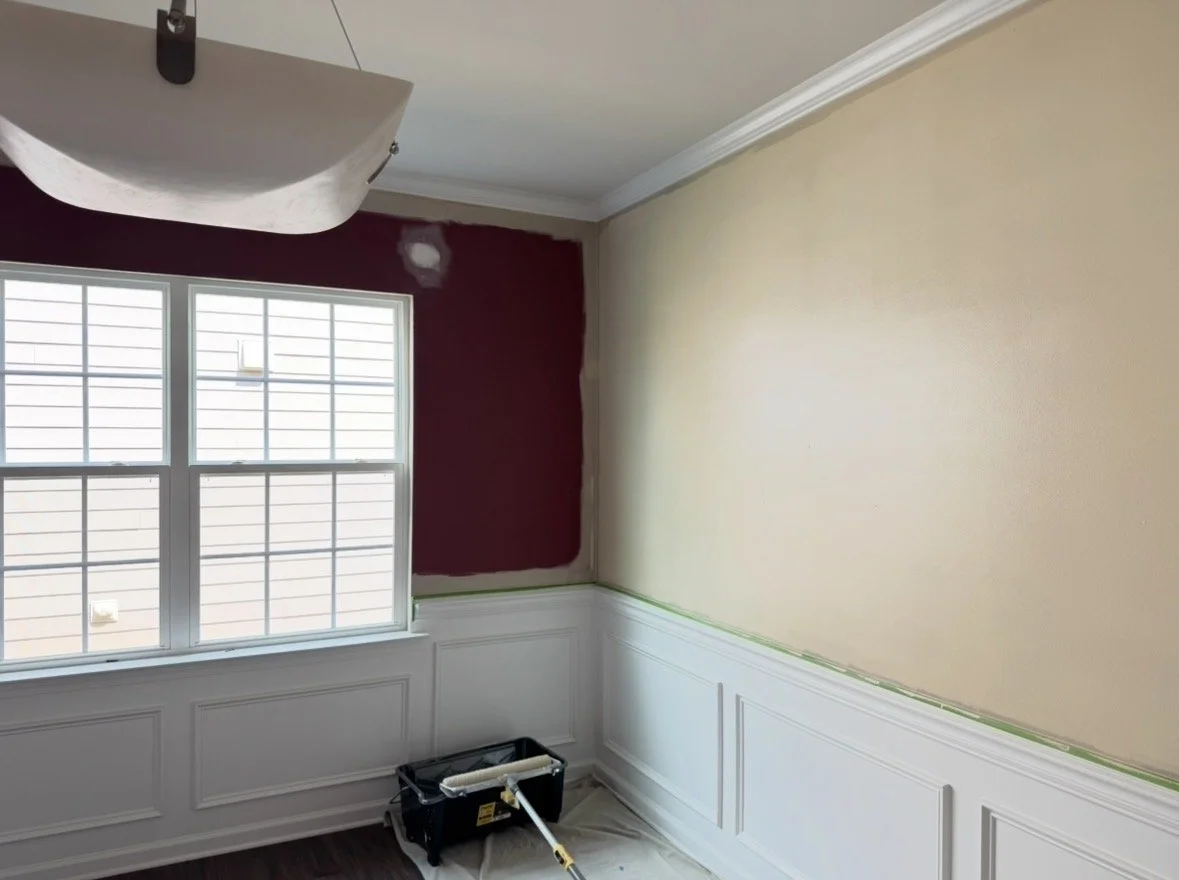
Drastic color changes. Going from a deep saturated color to a light one, or the reverse. A tinted primer gets you to a neutral base in one coat, which usually means two finish coats instead of four. This is the case where primer actively saves you money.
When you can honestly skip it
This is the half nobody tells you.
Repainting a clean, sound, previously painted wall in a similar color. The old paint is your primer. It's already sealed, already uniform, and the new coat will bond to it fine. Wash off any grease or grime, address the shiny spots, and paint.
Going darker over a light neutral. Coverage direction is in your favor. Two coats of a quality finish paint will get there.
Small color shifts within the same family. Greige to a slightly warmer greige doesn't need a reset coat.
Flat over flat, in good condition. The most forgiving scenario there is.
The test I use: is the wall clean, sound, sealed, and close in color? If yes to all four, primer isn't earning its place.
What about paint-and-primer-in-one?
It's a real product, not just marketing, but it's badly named.
What it actually is: a finish paint with a higher solids content, which builds a thicker film and covers better. That's useful. It is not a bonding primer, a stain blocker, or a drywall sealer, and it won't do any of those jobs.
Where it works: repainting a sound wall, moderate color changes, normal maintenance. Which is to say, the situations where you didn't need primer anyway.
Where it fails: every case in the list above. Marketing has convinced a lot of homeowners that this product removed the need to think about priming. It didn't.
A trick worth knowing: have your primer tinted
Most people don't realize primer can be tinted at all. It can, and on the right job it saves real money.
If you're using a premium paint — Benjamin Moore Aura, a designer line like Farrow & Ball, anything running north of $80 a gallon — the expensive part is the finish coat. So reduce how much of it you need. Have the primer tinted toward your finish color, and the topcoat has far less work to do.
This matters most with colors that cover poorly. Deep reds, saturated blues, bright yellows, and most clear organic pigments are notoriously weak coverers — over a white primer they can take three or four coats to look right. Over a primer already carrying most of that color, you're often at two. Two saved gallons of a $100 paint more than pays for the primer.
The caveat. Primer can't absorb the colorant load a deep-base finish paint can, so you're not matching the color exactly. You're getting close — often what manufacturers call a gray-scale match, where they specify an undercoat shade calibrated to your particular color. Tell the counter what you're topcoating with and ask them to tint the primer to the recommended undercoat. They do this routinely. Some premium brands, Farrow & Ball among them, sell their own undercoats in tones matched to their palette.
And tinting doesn't change which primer you need. A stain-blocking job still needs a stain blocker; a glossy surface still needs a bonding primer. Tinting is a coverage strategy layered on top of the right product choice, not a substitute for it.
What actually happens if you skip it
On bare drywall or patches: flashing. The wall looks blotchy in raking light, with dull spots exactly where the repairs were. The fix is to prime and repaint the whole wall, so you've now done three coats instead of two.
On a glossy surface: adhesion failure. Not immediately — usually weeks or months later, when the paint peels or chips away in sheets. On cabinets and trim this is the most expensive mistake on the list, because stripping failed paint is far worse than the prep you avoided.
Over a stain: the stain comes back, sometimes within days. More finish coats won't stop it.
On a drastic color change: you'll get there eventually, at four or five coats instead of two, having spent more on finish paint than primer would have cost.
None of these are catastrophes. All of them cost more to fix than to prevent.
A note on Charlotte homes specifically
Two things I see regularly in this area.
Newer construction still wearing its original builder finish often has areas that were never properly primed to begin with — closets, garages, and behind where appliances sat.
And older homes carry a real chance of oil-based paint on the trim. If you're not sure, wipe an inconspicuous spot with denatured alcohol on a rag. If paint comes off, it's latex. If nothing happens, it's likely oil, and it needs a bonding primer before anything else goes on it.
The short version
Prime when the surface is new, repaired, stained, glossy, or dramatically the wrong color. Skip it when you're repainting a clean, sound wall in a similar shade.
If you're standing in the room unsure which one you've got, that uncertainty is itself worth something — it usually means there's a condition on the wall you can't quite read. That's a good moment to have someone look at it before you commit two days to painting it twice.
Frequently asked questions
Do I need to prime before painting over existing paint?
Usually not, if the existing paint is clean, sound, and reasonably close in color. Prime if you're covering a stain, going over a glossy finish, or making a drastic color change.
Does paint and primer in one actually work?
It works as a higher-solids paint with better coverage. It does not replace a bonding primer, a stain-blocking primer, or a drywall sealer, and it shouldn't be used in place of one.
Do I need primer when painting new drywall?
Yes. Bare drywall paper and joint compound absorb at different rates, and painting straight onto them makes every seam visible as a sheen difference.
Can I just use extra coats of paint instead of primer?
For coverage, sometimes. For adhesion or stain blocking, no — those are chemical problems that additional finish coats can't solve.
Do I have to prime over spackle and patches?
Yes, spot-prime them. Unprimed patches are the most common cause of blotchy-looking walls after an otherwise good paint job.
Can you tint primer?
Yes, and it's underused. Tinting the primer toward your finish color cuts the number of finish coats needed, which matters most with poor-covering colors and premium paints. Primer holds less colorant than finish paint, so ask for the recommended undercoat shade rather than an exact match.
How do I know if my trim is oil-based?
Rub an inconspicuous area with denatured alcohol on a rag. If paint transfers to the rag, it's latex. If it doesn't, assume oil and use a bonding primer.
Not sure what your walls need?
Flexcoat serves Charlotte, Matthews, Huntersville, Ballantyne, and the surrounding area. We'll tell you straight whether primer is worth it on your job.
About the author. Jose Rivera is the owner of Flexcoat, a veteran-owned painting company based in Charlotte, NC. A combat veteran with more than twenty years in the trade, he has spent that time helping homeowners find the right solution for their painting needs.