Does painting your house increase its value in Charlotte?
Selling your home
Yes — and it's one of the few home improvements that reliably returns more than it costs. But the useful question isn't whether. It's which rooms.
By Jose Rivera Owner, Flexcoat 20+ years Combat veteran
On most homes, a handful of targeted areas carries almost all of the benefit. Here's how that actually works.
What paint is actually doing for the sale
Two things, and they work together.
The first is that paint makes the house's own features legible. Crown molding, wainscoting, a chair rail, built-ins, the proportions of a good room — these get lost under tired, uneven, or badly matched paint. Done well, paint doesn't call attention to itself. It steps back and lets the architecture read. Buyers rarely say "the trim work is nicely finished." They say the house feels well built.
The second matters more: color determines whether a buyer can picture themselves living there. A good neutral is versatile. It works against a wide range of furniture and decor, so the buyer walking through can mentally set down their own sofa, their own art, their own life. That's the moment an offer starts forming.
A strongly personal color does the opposite. It pulls focus onto itself, and instead of imagining their own space, the buyer is reacting to somebody else's taste. It doesn't have to be an ugly color to cause this — a beautifully executed deep burgundy dining room still says this room belongs to whoever chose it. Neutralizing isn't about making a house boring. It's about handing the buyer a blank enough page to write on.
What a worn wall tells a buyer (fairly or not)
Hairline cracks above a doorway, a patch that was never sanded flush, flashing where someone touched up with the wrong sheen — none of that is necessarily a real problem. Minor settlement cracking is common in Charlotte's clay soil, and a previous owner's rushed touch-up says nothing about the roof, the HVAC, or the foundation.
But buyers don't evaluate it in isolation. They see a wall that wasn't taken care of and they extrapolate: if this was let go, what else was? The visible flaw becomes a stand-in for everything they can't see, and that assumption gets carried into the inspection, into the negotiation, and into the number on the offer.
You're not just fixing a wall. You're removing a reason for someone to wonder.
The art comes down, and then what
Every seller hits this one. You take down the family photos and the canvas over the sofa, and what's left behind is a constellation of nail holes — some small, some not.
And then there are the adhesive strips. The ones that promise a clean pull. Sometimes they deliver, and sometimes they come off the wall with a chunk of paint and a layer of drywall paper still attached, turning a pinhole into a torn patch the size of your hand. The convenient option stops being convenient right at the moment you need the wall to look its best.
No one walks away from a house over a nail hole. But it catches the eye, and a buyer standing in the living room studying a torn spot above the sofa is a buyer who isn't studying the room. These small things have a way of becoming the focus of the whole walkthrough.
Filling, sanding, and touching in is about as cheap as this work gets, and the return is out of proportion to the cost. It keeps attention where you want it — on what the house actually has going for it.
You don't have to repaint the whole house
Sellers often assume the choice is between doing nothing and repainting everything. It isn't. Here's a recent example from a Charlotte-area home going on the market.
The dining room
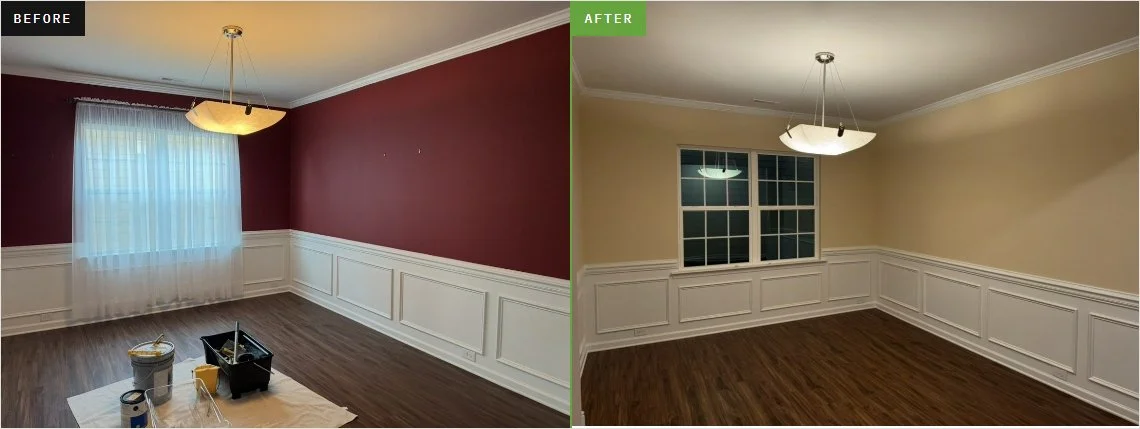
The burgundy was well applied and the wainscoting under it was in good shape. Nothing here was wrong. But the color dominated the room and demanded that a buyer's furniture work around it. Anyone who didn't already own a dining set suited to deep red had to do mental math before they could like the room.
The wainscoting, crown molding, and chair rail were never touched. That detail work was always there — against burgundy it read as a border, and against a warm neutral it reads as craftsmanship.
The great room
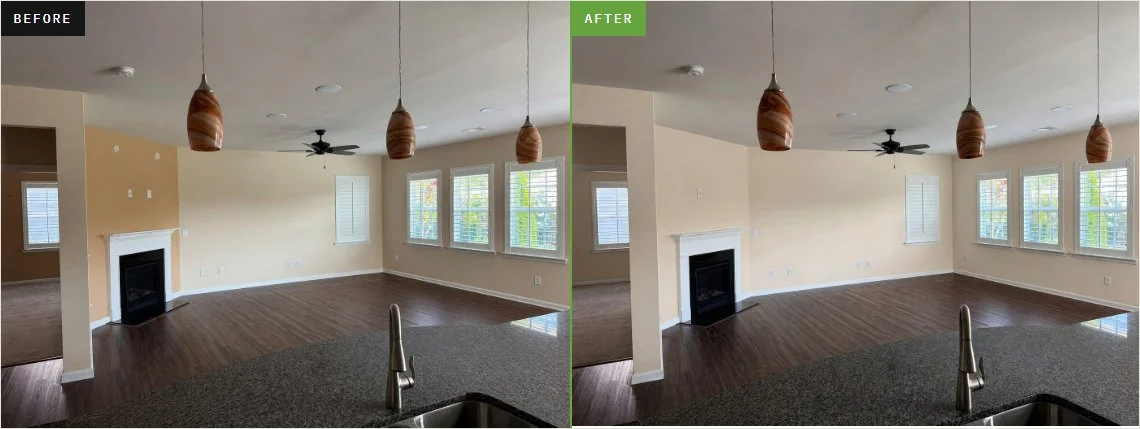
An accent wall is the most common thing sellers leave in place and often the easiest thing to fix. This one framed the fireplace in a color that fought the rest of the open floor plan, chopping up a sightline that runs through the kitchen and dining room.
That's one wall. A few hours of work. And the room stops competing with itself — the fireplace still anchors the space, but through the mantel and the proportions rather than through a color the buyer has to accept.
Why small changes do so much
Every element a buyer has to mentally negotiate carries weight. Would my furniture work in here? Would I have to repaint this? Do I even like that color? Each question is small, and none of them alone kills a sale. But they accumulate over a twenty-minute walkthrough, and the buyer leaves with a vague sense that the house is a project.
Neutralizing two or three rooms and eliminating a contrasting accent wall removes most of that weight. The bedrooms, hallways, and trim in this home were left alone. The money went where it changed the buyer's experience.
How Flexcoat approaches it
It's the easy answer for a painter to tell you the whole house needs painting. Bigger job, bigger invoice, no thinking required. Unless the house genuinely needs it, that advice isn't serving you.
Your best return doesn't come from painting the most square footage. It comes from identifying which areas carry the most weight with a buyer and building a plan around those.
That's what we do. We walk the house with you and put together a real strategy — what to neutralize, what to touch up, what to leave alone entirely. We won't recommend work that isn't going to return value to you, and if a room is already clean and neutral, we'll tell you to save your money. Then we do excellent work on the areas that matter.
The goal is a house that looks and feels new without the financial heavy lifting.
A quality paint job is not just paint
This is where most of the difference between two quotes lives. Paint is cheap — what you're paying for is everything before the first coat and the discipline in applying it.
The wall gets addressed, not covered. Settling cracks get cut out and repaired so they don't telegraph back through in a year. Nail pops, dings, old anchor holes, and previous patches that were never sanded flat all get dealt with. Paint over an imperfection and you've highlighted it — a fresh coat reflects light evenly, which makes every flaw underneath more visible, not less.
The right tools for the surface. Nap length matched to the wall texture, the correct brush for the trim, proper masking where it's needed. The wrong roller on a smooth wall leaves texture that wasn't there before, and it can't be fixed without sanding it back out.
Application you don't notice. No heavy stipple. No ropey brush marks on the trim. No lap marks where an edge dried before someone rolled into it. Consistent sheen across the whole wall. When the application is right, your eye takes in the color and the proportions. When it's wrong, your eye keeps catching on the surface itself — the opposite of what you paid for.
A buyer won't consciously inventory any of this. They'll come away feeling the house was cared for, or feeling something was a little off. That feeling shows up in the offer.
Timing
The one rule worth holding to: paint goes on before the listing photos. Those photos are the first showing, and most buyers decide whether to tour a house based on them alone.
Past that, timing is more flexible than most sellers assume. If you have a few weeks, there's room to work through the house methodically and handle whatever the prep uncovers. If you're listing in days, targeted work still moves the needle — the rooms in the photos first, then any accent walls, then trim.
This is where a plan matters more than a calendar. We've spent years strategizing cost-effective touch-ups on tight turnarounds, so timing doesn't have to be the thing standing between you and a listing date. Tell us when the photographer is coming and we'll build the scope around it.
Frequently asked questions
Do I have to repaint the whole house before selling?
No. On most homes, neutralizing two or three rooms and eliminating contrasting accent walls delivers the large majority of the benefit. Rooms that are already clean and neutral can usually be left alone.
What paint colors help a house sell in Charlotte?
Warm neutrals — soft whites, greiges, and muted earth tones. They photograph well under both natural and artificial light and let buyers imagine their own belongings in the room. Avoid stark cool whites in homes with limited natural light; they tend to read gray and cold in photos.
Should I paint before or after I list?
Before. Listing photos are the first showing, and most buyers decide whether to tour based on those images alone.
Are small wall cracks a sign of a structural problem?
Usually not — minor settlement cracking is common in this area. But buyers tend to read any visible flaw as evidence of broader neglect, which is why repairing and repainting before listing is worth doing even when the crack itself is harmless.
Is it worth painting kitchen cabinets instead of replacing them?
For most sellers, yes. Refinishing costs a fraction of replacement and delivers most of the visual update — provided it's done with proper prep and a sprayed finish. Brush marks and peeling on cabinet doors do more harm than dated cabinets.
Thinking about selling?
Flexcoat serves Charlotte, Matthews, Huntersville, Ballantyne, and the surrounding area. We'll walk your house with you and tell you honestly which rooms are worth painting and which ones aren't.
About the author. Jose Rivera is the owner of Flexcoat, a veteran-owned painting company based in Charlotte, NC. A combat veteran with more than twenty years in the trade, he has spent that time helping homeowners find the right solution for their painting needs.